Strength training at home in 15 minutes: why and how
Physical Activity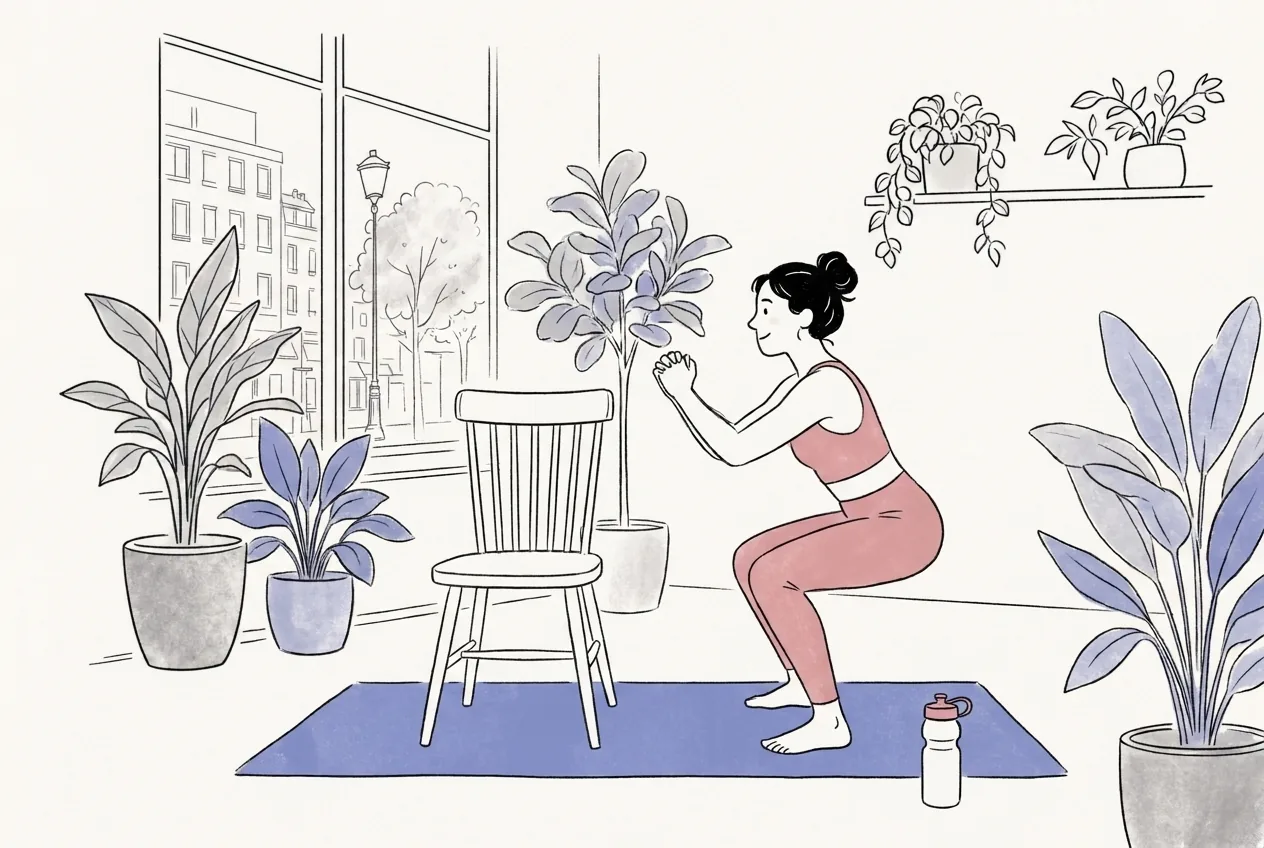
Key points
- Guidelines: muscle strengthening at least 2 days a week.
- 30 to 60 minutes of strength training a week is linked to a 10% to 20% lower risk of death and major chronic diseases.
- The best results come from combining strength and aerobic activity.
- Basic moves: squats, wall push-ups, lunges, glute bridges, planks.
Why strength training
Muscle mass and strength decline with age, starting as early as your 30s. Strength training preserves muscle and bone, improves balance and blood sugar control and makes daily tasks easier. Yet only about a third of U.S. adults meet the muscle-strengthening guideline.
What the research shows
A meta-analysis of 16 cohort studies found that muscle-strengthening activities were linked to a 10% to 17% lower risk of death from any cause, cardiovascular disease, cancer and diabetes. The greatest benefit was seen at 30 to 60 minutes a week, and combining strength with aerobic activity was linked to a 40% lower risk of death (Momma et al., 2022).
The Physical Activity Guidelines for Americans (Piercy et al., 2018) and the WHO (Bull et al., 2020) recommend strengthening all major muscle groups at least 2 days a week.
A 15-minute routine without equipment
Do each exercise for 40 seconds, rest 20 seconds, and repeat the circuit 2 to 3 times:
- Squats (or sit-to-stand from a chair).
- Push-ups against a wall, counter or the floor.
- Alternating lunges (hold a chair for balance).
- Glute bridges lying on your back.
- Plank on your knees or toes.
How to progress
- Add repetitions or sets.
- Slow down the movement.
- Use resistance bands or dumbbells.
- Try harder variations, such as push-ups on the floor instead of the wall.
Frequently asked questions
Do I need weights?
No. Body-weight exercises are enough to start; add resistance bands or dumbbells as you get stronger.
How many reps should I do?
Do 8 to 12 repetitions per exercise, to the point where the last few feel challenging, for 1 to 3 sets.
Sources
- Momma et al. (2022). Muscle-strengthening activities are associated with lower risk and mortality in major non-communicable diseases: a systematic review and meta-analysis of cohort studies. British Journal of Sports Medicine 56(13):755-763. doi:10.1136/bjsports-2021-105061
- Bull et al. (2020). World Health Organization 2020 guidelines on physical activity and sedentary behaviour. British Journal of Sports Medicine 54(24):1451-1462. doi:10.1136/bjsports-2020-102955
- Piercy et al. (2018). The Physical Activity Guidelines for Americans. JAMA 320(19):2020. doi:10.1001/jama.2018.14854
Keep reading
 Physical Activity
Sitting too much: the health risks of a desk job and how to offset them
Why prolonged sitting is linked to higher mortality even in people who exercise, how much activity offsets it and simple habits for the workday.
 Physical Activity
Walking: the simplest exercise with proven benefits
What meta-analyses show about walking, heart disease and longevity, how fast and how much to walk and easy ways to walk more every day.
 Physical Activity · Myth or fact
Do you really need 10,000 steps a day? What the research says
Where the 10,000-step goal came from and what meta-analyses show about daily steps and mortality by age, including where benefits level off.
Related topics from other pillars
Loneliness, hearing loss and dementia: what you can change
What the Lancet Commission found about 12 modifiable dementia risk factors, including social isolation and hearing loss, and practical steps to lower risk.
 Nutrition
Vitamin D: who really needs supplements?
What the VITAL trial and a meta-analysis of 81 randomized trials found about vitamin D supplements, and who may still need them.
Physical Activity tools
IPAQ: International Physical Activity Questionnaire (short)
Calculates your MET-minutes per week and your activity level.
QuizDo you meet the Physical Activity Guidelines? Check
Minutes of moderate and vigorous activity per week, plus strength training.
Quiz30-second chair stand test (for adults 60+)
How many times can you stand up from a chair in 30 seconds? Compared with CDC norms.
PDF · TrackerMonthly step tracker
Write down your daily steps and track your progress.
PDF · Log15-minute home strength workout + training log
A no-equipment routine with an 8-week rep log.
PDF · Card + trackerBalance exercises for adults 60+
A safe balance and leg-strength routine with a 4-week tracker.