Physical activity: how much exercise do adults need?
Physical Activity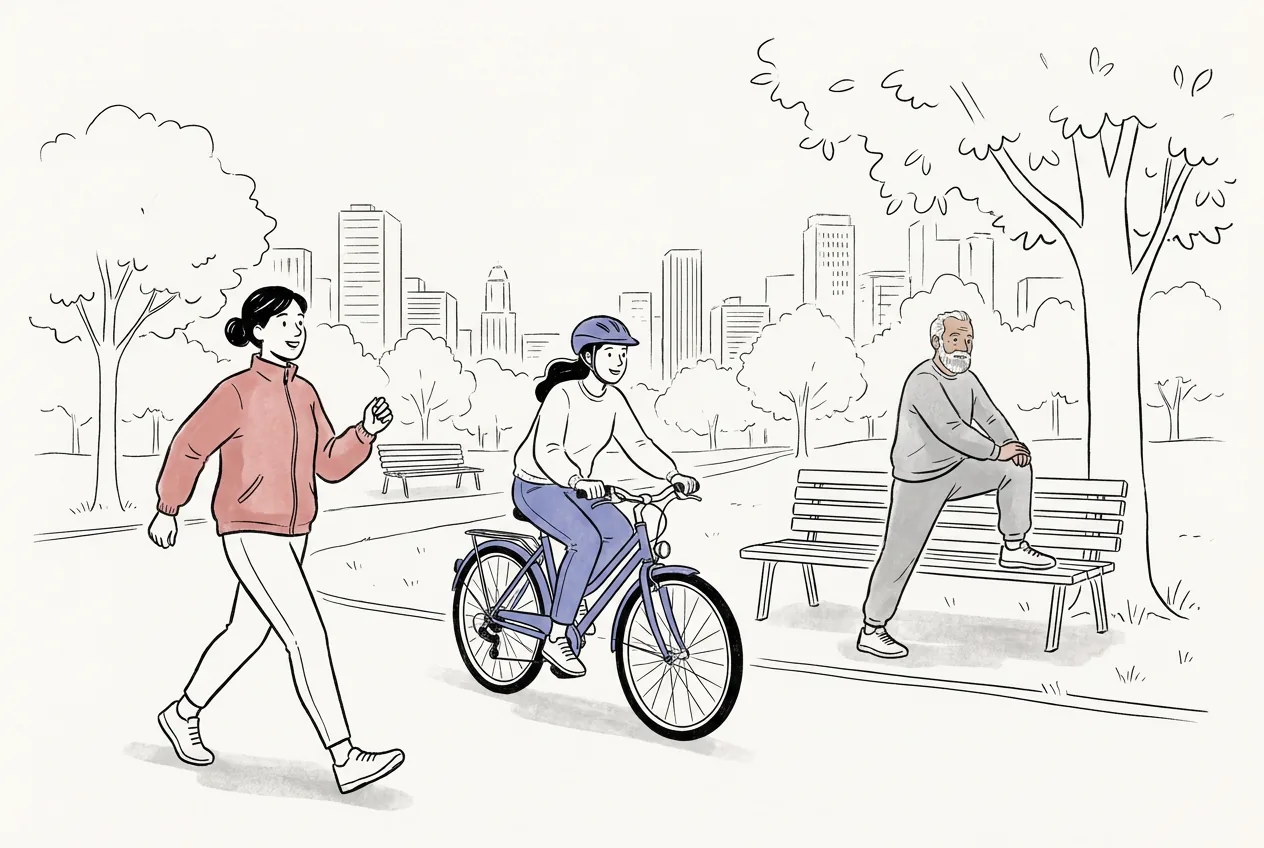
Key points
- 150 to 300 minutes of moderate activity a week is roughly 20 to 40 minutes a day.
- Muscle-strengthening activities for all major muscle groups at least 2 days a week.
- Adults 65 and older should add balance training to help prevent falls.
- Long hours of sitting are harmful, but 60 to 75 minutes of moderate activity a day largely offset the risk.
Why movement is its own pillar
Regular physical activity lowers the risk of heart disease, type 2 diabetes, several cancers, depression and anxiety. It improves sleep and thinking and preserves muscle and bone as we age. Yet according to the CDC, only about a quarter of U.S. adults meet both the aerobic and muscle-strengthening guidelines.
What the guidelines recommend
The second edition of the Physical Activity Guidelines for Americans was published in 2018 (Piercy et al., 2018), and the World Health Organization updated its guidelines in 2020 (Bull et al., 2020). For adults the numbers are essentially the same:
- 150 to 300 minutes of moderate aerobic activity a week, or 75 to 150 minutes of vigorous activity, or a combination;
- muscle-strengthening activity for all major muscle groups at least 2 days a week;
- sit less, and replace sitting with any activity, even light activity.
Adults 65 and older should follow the same targets as far as they are able, and add balance training to reduce the risk of falls.
“Move more, sit less”: every minute counts
One important change in the 2018 U.S. guidelines was dropping the requirement that activity last at least 10 minutes at a time. Any activity counts, and the people who gain the most are those who go from doing nothing to doing a little (Piercy et al., 2018).
So taking the stairs instead of the elevator, walking to the store or doing a few exercises between tasks are not trivial. They are part of your weekly total.
Sitting as a separate risk
Prolonged sitting is linked to higher mortality whether or not you exercise. A large meta-analysis of more than one million people found that 60 to 75 minutes of moderate activity a day largely offset the higher risk associated with long hours of sitting (Ekelund et al., 2016). Read more in our article on desk jobs.
A sample week
| Day | Example |
|---|---|
| Mon, Wed, Fri | 30 minutes of brisk walking |
| Tue, Thu | 20 minutes of home strength training: squats, wall push-ups, planks |
| Sat | A walk, bike ride or yard work |
| Every day | Stand up every 30 to 60 minutes of sitting |
How to start if you have been inactive
- Start with 10 minutes of walking a day.
- Add 5 minutes each week.
- After a month, add one or two short strength sessions.
- Choose activities you enjoy: consistency matters more than intensity.
Elsewhere in this section: how many steps you really need, how to stay active with a desk job and simple exercises you can do at home.
Frequently asked questions
What counts as moderate activity?
Activity that makes you breathe harder and raises your heart rate, but you can still talk, though not sing. Examples: brisk walking, cycling on level ground, yard work.
Do short walks count?
Yes. The 2018 Physical Activity Guidelines for Americans and the 2020 WHO guidelines dropped the old rule that activity must last at least 10 minutes. Every bit counts.
What if 150 minutes sounds impossible?
Start where you are, even with 5 to 10 minutes a day, and build up gradually. The biggest health gains happen when people go from no activity to some activity.
Sources
- Bull et al. (2020). World Health Organization 2020 guidelines on physical activity and sedentary behaviour. British Journal of Sports Medicine 54(24):1451-1462. doi:10.1136/bjsports-2020-102955
- Piercy et al. (2018). The Physical Activity Guidelines for Americans. JAMA 320(19):2020. doi:10.1001/jama.2018.14854
- Ekelund et al. (2016). Does physical activity attenuate, or even eliminate, the detrimental association of sitting time with mortality? A harmonised meta-analysis of data from more than 1 million men and women. The Lancet 388(10051):1302-1310. doi:10.1016/S0140-6736(16)30370-1
- U.S. Department of Health and Human Services. Physical Activity Guidelines for Americans, 2nd edition. health.gov
Keep reading
 Physical Activity · Myth or fact
Do you really need 10,000 steps a day? What the research says
Where the 10,000-step goal came from and what meta-analyses show about daily steps and mortality by age, including where benefits level off.
 Physical Activity
Sitting too much: the health risks of a desk job and how to offset them
Why prolonged sitting is linked to higher mortality even in people who exercise, how much activity offsets it and simple habits for the workday.
 Physical Activity
Strength training at home in 15 minutes: why and how
Why guidelines recommend muscle strengthening twice a week, what a meta-analysis found about strength training and longevity, and a 15-minute no-equipment routine.
Related topics from other pillars
Loneliness, hearing loss and dementia: what you can change
What the Lancet Commission found about 12 modifiable dementia risk factors, including social isolation and hearing loss, and practical steps to lower risk.
 Nutrition
Vitamin D: who really needs supplements?
What the VITAL trial and a meta-analysis of 81 randomized trials found about vitamin D supplements, and who may still need them.
Physical Activity tools
IPAQ: International Physical Activity Questionnaire (short)
Calculates your MET-minutes per week and your activity level.
QuizDo you meet the Physical Activity Guidelines? Check
Minutes of moderate and vigorous activity per week, plus strength training.
Quiz30-second chair stand test (for adults 60+)
How many times can you stand up from a chair in 30 seconds? Compared with CDC norms.
PDF · TrackerMonthly step tracker
Write down your daily steps and track your progress.
PDF · Log15-minute home strength workout + training log
A no-equipment routine with an 8-week rep log.
PDF · Card + trackerBalance exercises for adults 60+
A safe balance and leg-strength routine with a 4-week tracker.