Waking up at night: what is normal and what is not
SleepKey points
- Brief awakenings during the night are normal.
- Time awake at night increases with age even in healthy people.
- Worrying about waking up itself makes it harder to fall back asleep.
- CBT-I helps with frequent, long awakenings.
What the research shows
Sleep runs in cycles of about 90 minutes, and brief awakenings between cycles are normal. Most of them are so short we do not remember them.
Reference data. A study of polysomnography in healthy adults without sleep complaints found that time awake after sleep onset increases steadily with age, while deep sleep decreases (Hertenstein et al., 2018).
Meta-analysis. A meta-analysis of sleep studies from childhood to old age showed that total sleep time, sleep efficiency and deep sleep decline with age, while awakenings increase (Ohayon et al., 2004).
What helps
- Do not look at the clock.
- If you cannot fall back asleep within about 20 minutes, get up, go to another room and do something calm in dim light until you feel sleepy.
- Avoid screens and bright light during the night.
- Limit fluids in the 2 hours before bed and alcohol in the evening.
- If awakenings are frequent and long, CBT-I is the most effective treatment (Trauer et al., 2015).
Frequently asked questions
Is waking at 3 a.m. a sign of something wrong?
Not necessarily. Brief awakenings between sleep cycles are normal; they only matter if you cannot fall back asleep and feel tired during the day.
Should I check the time when I wake up?
No. Clock-watching increases anxiety. Turn the clock away from the bed.
Sources
- Hertenstein et al. (2018). Reference Data for Polysomnography-Measured and Subjective Sleep in Healthy Adults. Journal of Clinical Sleep Medicine 14(4):523-532. doi:10.5664/jcsm.7036
- Ohayon et al. (2004). Meta-Analysis of Quantitative Sleep Parameters From Childhood to Old Age in Healthy Individuals: Developing Normative Sleep Values Across the Human Lifespan. Sleep 27(7):1255-1273. doi:10.1093/sleep/27.7.1255
- Trauer et al. (2015). Cognitive Behavioral Therapy for Chronic Insomnia. Annals of Internal Medicine 163(3):191-204. doi:10.7326/M14-2841
Keep reading
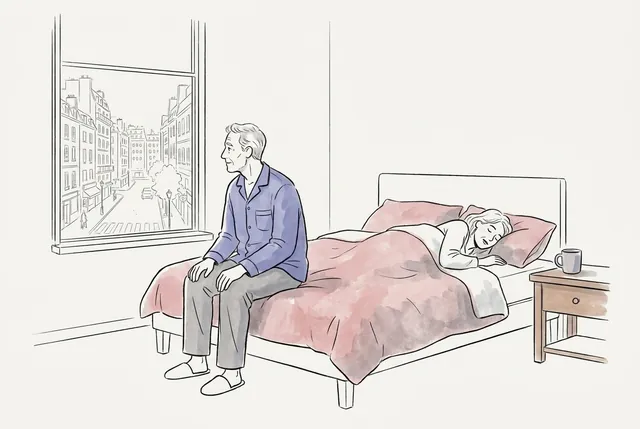 Sleep
How sleep changes with age and what to do about it
How deep sleep and nighttime awakenings change across the lifespan, how much sleep older adults need and why sleeping pills are risky after 65.
SleepSleep and your heart: how sleep duration is linked to heart attack and stroke
What a meta-analysis of 15 studies with 470,000 people found about short and long sleep, heart disease and stroke, and why sleep apnea matters.
 Sleep
Light and your body clock: how to reset your sleep schedule
Why light is the main signal for your circadian rhythm, what studies show about morning light, camping and evening screens, and how to use light to sleep better.
Related topics from other pillars
Progressive muscle relaxation: a simple technique for anxiety
What progressive muscle relaxation is, what a meta-analysis found about relaxation training for anxiety and a step-by-step 10- to 15-minute routine.
Physical ActivityExercise and sleep: how physical activity helps you sleep
What a meta-analysis of 66 studies found about exercise, sleep duration and sleep quality, and whether evening workouts keep you awake.
StressCBT self-help: does it work without a therapist?
What a meta-analysis found about guided self-help based on cognitive behavioral therapy for depression and anxiety, and how to choose a good program.
Sleep tools
How much sleep do you need? Recommendations by age
Recommendations from the American Academy of Sleep Medicine and the National Sleep Foundation.
QuizSocial jet lag calculator
The difference in your sleep midpoint between workdays and days off.
QuizWhen should you stop drinking coffee? Calculator
According to a meta-analysis, have a regular coffee at least about 8.8 hours before bed.
PDF · DiaryTwo-week sleep diary
Record bedtime, wake time, awakenings, caffeine, alcohol and how you feel.
PDF · TrackerMonthly 24-hour sleep tracker
A visual sleep rhythm tracker that shows your schedule and social jet lag.
PDF · ChecklistBedtime routine checklist
A step-by-step wind-down routine with a weekly tracker.